Founded in 1976, Habitat for Humanity is a global nonprofit housing organization in nearly 1,400 communities across the U.S. and in approximately 70 countries around the world, and has helped more than 13 million people. Habitat works to build strength,
stability, and self-reliance in partnership with families in need of decent and affordable houses. Habitat doesn’t just give away houses, instead the families help build their own homes alongside volunteers and pay an affordable mortgage.
One of the top Habitat for Humanity chapters in the U.S. is located in Tulsa, Oklahoma. Our Tulsa office and employees have supported Tulsa Habitat through many different initiatives, including competing in a design competition to create a new home design
for Tulsa Habitat.
It was imperative that Tulsa Habitat make a change to the homes they were building for these families to better fit the family needs and the neighborhood where they were being built. One of the advantages historically is the equity the home has when completed
above market value. Unfortunately this wasn’t the case for the homes being built for Tulsa families after about 2010. Tulsa Habitat agreed to allow the American Institute of Architects (AIA) Eastern Oklahoma chapter to sponsor a design competition
for a new prototype design. The judges included representatives from Hilti International, George Kaiser Family Foundation, and a past chair of Habitat International. The desire was for a design that featured a modern, open-living plan that could be
easily replicated and built at a reasonable cost, while also fitting the craftsman style of the Kendall Whittier neighborhood initially.
The Winning Design
Dewberry Associate Principal and Tulsa Design Director Jonathan Crump’s design was selected as the best fit for this new vision. His design featured a bungalow-style home with three bedrooms, two bathrooms, and a one-car garage. His prototype is
also easy to replicate and adaptable with variations to fit the family with as many as four bedrooms—all on a typical 50 foot by 100 foot lot. Jon’s design embraced the neighborhood with a featured front porch, which helps create an atmosphere
that interacts with the people in the community.
The first home using the new design was completed in 2016. The detailed craftsman elements combined with modern paint schemes gives the average person no indication that it’s a Habitat home. The focus on infill and redevelopment conserves Tulsa’s
open space and reduces the carbon footprint, which is a goal of Habitat. The prototype received the AIA Eastern Oklahoma Citation Award for Residential Architecture.
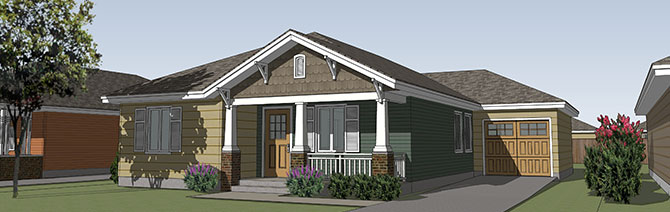
The prototype of the winning design features a one-car garage and front porch, which are some of the standard features that come with this design for each family.
Tulsa’s Habitat Future
The success of this prototype has been well received by the community and has earned sponsorship to build more homes. There have been close to 30 houses built using Jon’s design, including one that was completed in a 24-hour timeframe for a local
school teacher by the Tulsa Home Builder’s Association.
These new homes are a part of a renaissance of the Kendall Whittier neighborhood that’s focused on education, economic development, sustainability, infrastructure, and job creation.
Members of our Dewberry team have also helped develop the first multi-family concept design for Tulsa Habitat that has led Tulsa Habitat to receive several million dollars in grants for this new product type.
Working with Habitat has allowed our team to champion around a cause and show passion for a better community that we live and work in, while also contributing our talents to serve our neighbors in need of affordable and economical homes.
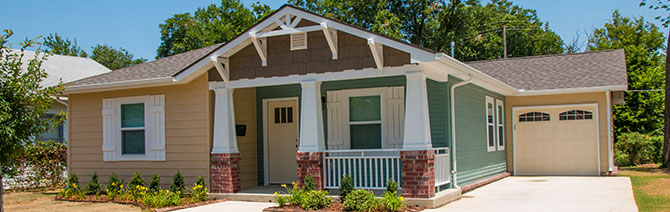
There have been more than 30 homes built since Tulsa Habitat started using this new design in 2016.
About the Author