The challenge of dealing with mental health issues is becoming an important design consideration in institutional facility planning, particularly when it comes to correctional and secure mental health models.
While there are many shared concerns between them, like unit size, security considerations, dayrooms, staff stations, and access to exterior exercise, the actual facilities can look very different.
Let the Facility Fit the Patient
Correctional mental health facilities house individuals who’ve been convicted of major crimes while suffering from significant mental health issues and wild behavior. The secure mental health model is designed for those who may have committed a serious crime but are not guilty by reason of insanity or simply too unstable to stand trial. In the latter case, they are regulated to such a facility until they are able to stand trial.
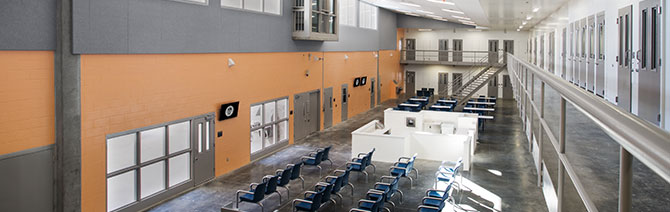
Correctional rooms are more akin to cells. A single inmate is often confined to a room with a stainless steel combination toilet-lavatory fixture, while nursing stations (with added security posts) are separated from, but may open directly onto, a main dayroom.
By contrast, mental health rooms are more like hospital rooms. Patients are more likely to be in a combination of single or double “dry” rooms (no toilets) while an adjacent area houses toilets, lavatories, and showers. Since this type of model revolves even more around nurse-to-patient interaction, the nursing station is designed closer to the dayroom.
Designed to Encourage
Regardless of the model we’re working with, we create environments that encourage rehabilitation and therapy by opening areas to natural light and exterior green space. We do this as much as the model will allow while providing programming areas for counseling, education, and staff interface.
Often, our designs reinforce privilege systems. As patients get better, they’re allowed access to more amenities and a more normalized environment – like eating at a central dining room or going to a barbershop. Such encouragement could even be as simple as using a classroom or exercise area that overlooks an outdoor community square.

Mental Health Issues in Jails
Jails, along with emergency rooms, have become a major dumping ground for mentally ill folks in our communities. There’s a tremendous need to provide an alternate place where officers can take those creating disturbances but committing no crime.
Some communities are developing non-secure facilities that cater to this situation. These “crisis stabilization centers” perform a much needed service. While it doesn’t replace the need for mental health services in jails for those who have been charged, crisis stabilization centers get more attention when 10-20 percent of a locally jailed population creates 80-90 percent of the problems.
Make no mistake, dealing with the challenge of mental health issues will only become more important in the design of tomorrow’s institutional facilities.