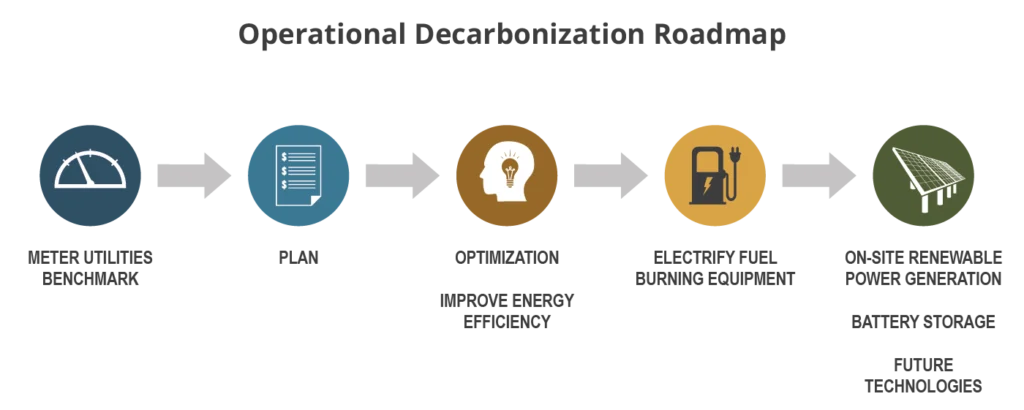
As the White House continues to encourage healthcare facilties and owners to move towards net zero goals, we’re excited to support clients in their efforts to work towards those same goals. A few months ago, we kicked off this blog series by discussing ways to decarbonize your healthcare facilitity. As a follow up, we want to take a closer look at the electrification process along that roadmap.
What is Electrification?
Electrification is the simple process of shifting on-site fossil fuel burning equipment to electric power. This includes hot water boilers, gas-fired water heaters, gas-fired kitchen equipment, fossil-fuel-burning generators, and gas-burning, hospital-owned vehicles. With the right technology, electrification provides the opportunity to reduce energy consumption and save on operating costs.
Why is it Important?
- Improves efficiency
Beneficial electrification refers to an all-electric option that reduces energy usage, therefore being beneficial both from an efficiency and a carbon footprint perspective. For example, if we compare the operating costs of a 92% efficient condensing-style boiler to a heat pump with a coefficient of performance (COP) of 3.2, we can illustrate the energy consumption and cost savings. For this example, let’s assume our facility consumes 100,000 therms of heating annually. For a 92%-efficient boiler, 100,000 therms of required heat would mean the facility purchases 108,696 therms of natural gas annually. If the facility instead utilized a heat pump, the facility would only be required to purchase 31,250 therms, or 915,885 kilowatt hour (kWh) of electricity. The cost implications will vary depending on the service type, service size, and utility, but if we assume 58 cents/therm and 6.5 cents/kWh, the annual cost savings our facility would see would be $3,500.
With the right technology, electrification provides the opportunity to reduce energy consumption and save on operating costs.”
Natalie MacDonald and Andrew Benson
- Reduces carbon emissions
Another driving factor for electrifying your facility is to reduce your direct carbon emissions. Shifting from on-site fuel burning equipment to electrically powered equipment from the grid has a direct impact on your facility’s Scope 1 emissions, and is often an opportunity for cleaner power. This does, however, depend on the carbon intensity of the grid in your area. To see how carbon intensity breaks down for each state, check out the EPA’s interactive eGRID Data Explorer chart.
Let’s consider North Carolina as an example. In North Carolina, 108,696 therms of natural gas annually would emit about 637 tons of carbon dioxide equivalent per year. However, utilizing a 3.2 COP heat pump, or 915,628 kWh per year, the facility would emit only 297 tons of carbon dioxide equivalent per year. This switch results in a significant reduction in both direct emissions and net emissions at the facility’s site as well as an improvement in air quality at the facility.
- Improves facility resilience
Electrification can also help improve resilience and allow the opportunity for facilities and campuses to become more energy independent through the integration of microgrids that incorporate energy storage and renewables. Grid-interactive efficient and electrified buildings provide facilities the ability to withstand, respond, and recover from disruptions in the grid and integrate demand control strategies at their facility.
In part three of this series on decarbonization and electrification, we dive into specific ways to electrify your healthcare facility, including kitchens, domestic hot water, heating hot water, chillers, and steam systems.
Click here to read part 1 of this blog series on facility decarbonization and here for part 3.
About the Authors

Natalie MacDonald