Five months ago, McGraw-Hill Construction in partnership with AIA released a study that found a lack of awareness regarding the impact of office buildings on employee health and wellness. In March of this year, USGBC COO Mahesh Ramanujam delivered a talk titled, “Healthy Buildings and Healthy People: The Next Generation of Green Building,” at the Tenth International Conference on Green and Energy-Efficient Building & New Technologies and Products Expo.
In an age driven by sustainability and social responsibility, could healthy buildings be the architectural industry’s next great call to action?
Could Healthier Buildings Reduce Employee Absenteeism and Encourage Healthy Habits?
A quarter of human resource executives consider absenteeism to be one of the top causes of lost productivity. Half of those absences are caused by cold and flu symptoms while another 20 percent are the result of headaches, migraines, and psychological depression.
Many industries rely upon the expertise of its employees, and the absence of a single team member can significantly impact a project’s timeline. When they miss time at work, the team is missing a valuable player. What if building designs could reduce absences? Could that flu have been avoided with more natural ventilation? Would that migraine have been so strong if more effective acoustics kept noise pollution in check? Could an employee’s unbalanced circadian rhythm have been positively affected by more access to natural light?
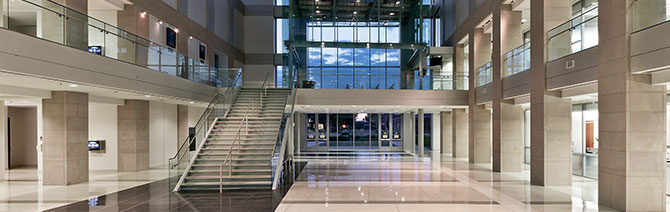
For decades we’ve placed staircases in windowless central cores of buildings, but what if we designed them differently? If we put staircases in the front of buildings and surrounded them with natural light, would that encourage more people to use them instead of the elevator? These are the questions we need to start asking ourselves.
As architects, we are licensed to protect the health, safety, and welfare of the people who use our buildings – and we also have the opportunity to improve the occupants’ health, safety, and welfare.
Decreasing Short Term Physical Illness in the Workplace
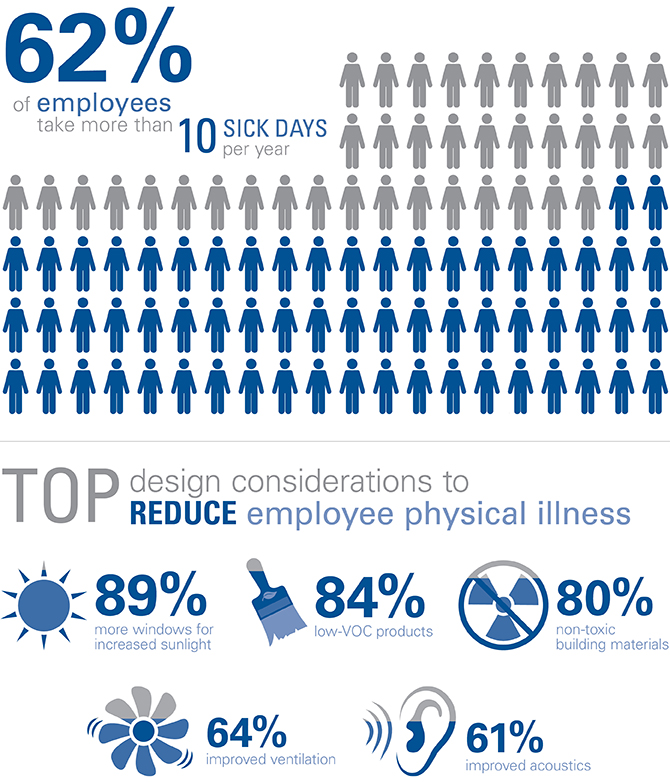
Short term physical illness is the number one reason employees are absent from the office. According to a study that surveyed employers, 62 percent of employees take more than 10 sick days a year. The same study also shows that certain healthy building designs are already being adopted to help reduce the impact (and occurrence) of illness in the workplace. About 90 percent of designers are incorporating more access to natural sunlight; 84 percent are using paints, adhesives, solvents, and other post-construction products that have less volatile organic compounds (low-VOC); and 80 percent are replacing manufactured building materials with non-toxic ones such as clay, sand, and timber.
Is this the Future of Social Responsibility?
The study found that building owners value costs savings and building aesthetics more than anything else. The study also found that architects rank health and productivity among the most crucial of decisions, meaning that we have a responsibility to make healthy buildings both practical and beautiful.