Oklahoma State University (OSU) has long been recognized for its commitment to healthcare education, and in particular its mission of training physicians, scientists, healthcare professionals, and first responders to serve rural and underserved areas
of Oklahoma and beyond. In recent years, we have assisted the university with the design of the new Allied Health Building in Oklahoma City, followed by the 84,000-square-foot Tandy Medical Academic Building on the Center for Health Science Campus
in Tulsa. Both of these facilities accommodate state-of-the-art, hands-on instruction in medical education.
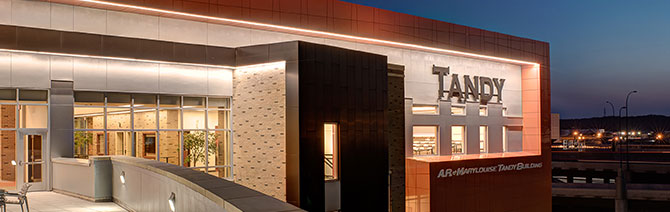
The OSU Allied Health Building and the Tandy Medical Academic Building showcase the latest programming in integrated active learning for science-based environments. Active learning environments at the university level in the U.S. first started to emerge
in recent years following the successes of the TEAL (Technology Enabled Active Learning) approach initiated at the Massachusetts Institute of Technology and the SCALE-UP (Student-Centered Active Learning Environments with Upside-Down Pedagogies) approach
launched at North Carolina State University. Today, hundreds of universities have embraced this approach for a variety of subjects, including math, physics, chemistry, engineering, and more recently, healthcare.
SCALE-UP: Collaboration and Task-Based Interaction
With the SCALE-UP approach, students work in teams, investigating and exploring a task or problem. In a healthcare education setting, this often includes hands-on simulation exercises. When active learning classrooms are paired with medical labs, the
pedagogy of small-group dynamics flows seamlessly between the classroom and lab. Rather than presenting coursework in a lecture format within the classroom, instructors roam the classroom to interact with the student-led teams in the same manner that
they teach within the laboratory.
The approach requires alternative concepts for classroom design reinforced with traditional tools such as whiteboards and interactive technologies that allow detailed discussions to proceed for an individual level or for a small group or entire class.
The group dynamics overlaid with engaged technology allows varied topics of learning to proceed simultaneously, then come together for improved outcomes for the entire group.
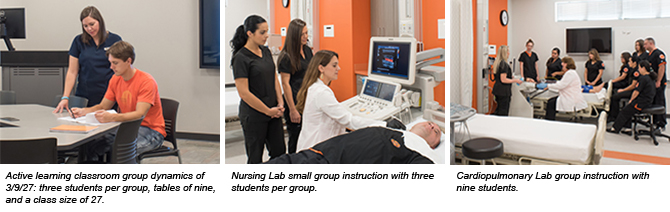
At the OSU Allied Health building, a nine-station active learning base supported the nursing curriculum when paired with the nursing lab and cardiopulmonary lab settings. Following the SCALE-UP methodology utilizing a base group of three students, consensus
or unanimous decisions support academic learning.
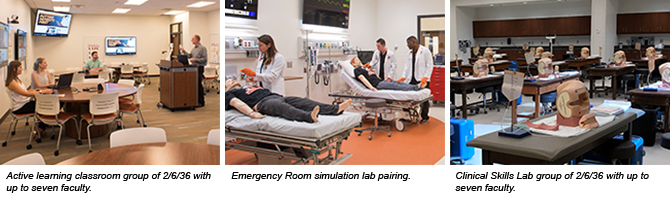
At the OSU Tandy Medical Academic Building, the typical Scale-Up model was adjusted to work with Osteopathic Clinical Problem-Solving pedagogies focusing on a lab pair as the base of the small group dynamics. The active learning tables combine three student
pairs with a medical professional or faculty member for an active learning table setup with seven stations. With the base student group of two, split decisions or consensus decisions support academic learning. This model is supported by incorporating
several advisors into the group dynamics fostering student-centered learning while facilitating the primary faculty instructor’s role of teaching.
These classrooms are actively demonstrating the task-based student engagement with peer instruction is an effective tool for medical education for the 21st century.
About the Author