As Rick Davidson noted in a recent blog, justice architecture is not set in stone. Rather, it evolves to fit the needs of today’s civilization – one filled with redemption opportunities along the path of reintegration into society.
Towards the end of last year, I was invited to talk about creating family friendly correctional spaces in Correctional News’ November-December 2014 issue. This focus on facilitating family support has been sparked by the rise in female prisoners throughout the last 20 years and our nation’s high recidivism rates. Evolving architectural trends, like reevaluating family visitation areas, can be a big part of post-incarceration success.
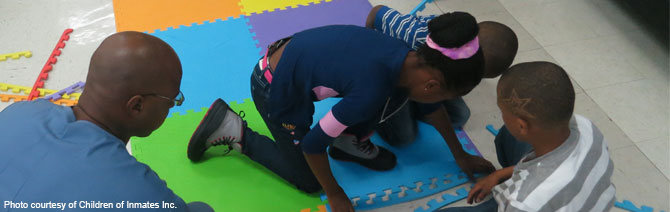
Family friendly correctional visitation spaces remind incarcerated parents of their responsibilities outside prison fences and can empower them to become better citizens upon release.
A Good Idea, Not Always Easy to Implement
While adoption of more family friendly visitation areas has increased in recent years, more needs to be done in order to make these areas a facility standard. It’s not the lack of conclusive research that’s inhibiting them from becoming the norm. In fact, just making clients aware of the national conversation is usually all it takes to encourage addition to new facilities. Rather, the barriers include policy, existing space, and infrequent visitation.
Most state systems understand the benefits of nurturing family bonds but may still lack policies that encourage (or even permit) family visits in a particular facility.
Prisons and jails are remarkably timeless buildings and can be used for more than 50 years. With such a long lifespan, many of the facilities in operation today were designed to meet standards generated years ago when the incarcerated population was even more gender skewed than today’s 82 percent male demographic.
Finally, geography, transportation, or even the stigma of a prison could be enough to keep families away, thereby creating an unsolvable catch-22: without family friendly visitation space, visitors may not come, but without visitors there’s no proof of need.
Changing The Future of Prison Operations By Starting Today
Many of the plans I bring to the table are influenced by social services. These tried-and-true designs have been honed over decades by agencies like Child Protective Services that exist to repair the emotional and physical damages tearing families apart. The designs are focused on building relationships, a new focus for corrections in the U.S.
It’s clear that design policy can have obvious operational implications for decades down the road. I believe family friendly visitation areas are an opportunity to make a poignant change in our treatment of inmates – to recognize them as recovering members of society.
We must begin leveraging family ties as a way to support inmates along the path to post-incarceration reintegration.
To learn more about creating family friendly correctional spaces, read Meg’s article in Correctional News.
About the Author