The worldwide expansion of shale oil and gas production is a direct result of technologies that have evolved over the years in the drilling industry—allowing the U.S. to become more energy independent.
The Evolution of Directional Drilling
To access oil and gas in the past, a vertical well would be drilled into the rock formation, accessing only a minimal percentage of the resource. Directional drilling was feasible, but required frequent trips to the bottom of the well to survey exactly where the drill bit was located.
Now, steering the drill bit through a rock formation allows for improved directional drilling and the ability to drill horizontally. With current ‘measure while drilling’ technology, location, depth, orientation, and penetration rate of the drill bit is known. The position of the drill bit can be adjusted from the surface. And in some cases, direction can be given while the well is being drilled from teams located in multiple locations around the world.
Refinement of Well Completion Technology
Hydraulic fracture of oil and gas bearing rock formations is a practice that has been safely used for decades, but its importance as a method for freeing natural gas and oil contained in shale rock formations has increased. The ability to steer the drill bit horizontally and release the hydrocarbons from shale rock has improved recovery from oil and gas wells drilled into shale formations worldwide.
Becoming Energy Independent in the U.S.
Here in the U.S. we’re fortunate to have multiple geologic shale formations. Many are tapped in the same manner as the Marcellus Shale and Utica Shale in Pennsylvania, Ohio, West Virginia, Maryland, and New York. Geologists have long known the capabilities of shale rock formations to hold oil and gas, but the key to unlocking their ability to release oil and gas have only recently allowed commercial recovery of the vast resources.
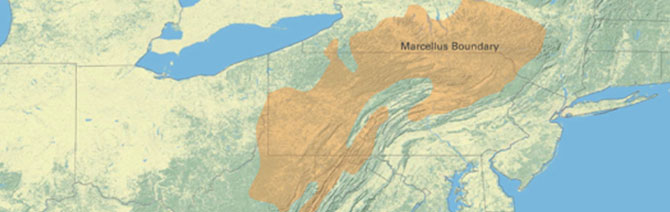
Marcellus Shale Boundary
The Marcellus Shale footprint extends across multiple states and is estimated to be the second largest gas field in the world—second only to a gas field in Saudi Arabia. For many years, the Appalachian Basin has been a second tier production area; usually only capable of producing oil and gas volumes far less than wells in Texas, Alaska, the Middle East, and offshore of the Gulf of Mexico.
With the ability to extract oil and gas through hydraulic fracture from the Marcellus Shale, the Appalachian Basin has become a player on the world’s energy stage, and will continue to have many positive impacts on the worldwide balance of energy—meaning greater energy independence for the U.S.