When designing a multi-purpose championship field, like the University of Texas at Austin’s Clark and Whitaker fields, many factors must be accounted for to enhance the community and be eco-friendly.
Getting Students Active
To offset an institution’s athletic persona, it’s imperative to create a venue that will bring students to campus, as well as keep others on. You want to improve visibility to better connect the campus, as well as increase its natural beauty to make it eye-catching.
To improve the facility for students, special consideration should be given to program elements, including a multi-use field, and venue size. Field overlap and safety zones, as well as parking and service buildings, must be mapped out. Significant focus should be placed on seating to better accommodate fans and supporters. Additionally, amenities such as lighting, sound system, and scoreboards, should be considered.
Creating a site plan in the initial stages of field design is necessary to define the field’s location. Emphasis should be placed on features such as lighting, solar orientation, and drainage. Examine the geometry of the location to better adjust field essentials to the site.
Sustainable Strategies
A priority of designing the UT Austin Clark and Whitaker fields was to integrate sustainable strategies in the fields’ design. In this particular project, it was necessary to address matters of soil that could expand when wet and potentially ruin the artificial turf, as well as issues related to the floodplain, water quality in the adjacent creek, and concerns about lighting and sports performance. Additionally, LED fixtures and zoned lighting save power, recycled pavement was utilized, and tapping into the existing water supply avoids toxic fertilizers.
Cost
Many field elements depend on the budget; define this in the early phases of the design process. The total budget consists of the cost of work, potential escalation, owner’s costs, and funding (interest). Funding is broken down into six elements: referendum, donations, grants, collaborative funding, sponsorships and advertising, and shared revenue.
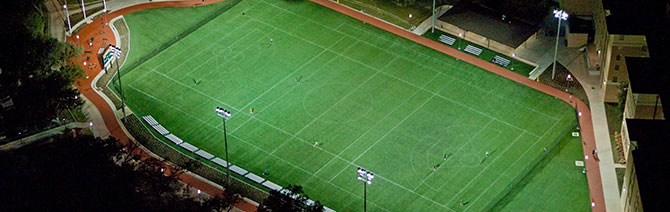
The Division of Recreational Sports at UT Austin is a leader in campus recreation, and providing quality student life programs, building leaders, and promoting a healthy lifestyle.
About the Authors
Anita Moran