Gopher tortoises (gopherus polyphemus) are ancient—their ancestors are a species of land tortoise that originated in western North America 60 million years ago. Of five North American tortoise species (genus gopherus), the gopher tortoise is the only one that lives east of the Mississippi River. The western population of gopher tortoise—west of Mobile River in Alabama and Mississippi—is currently listed as threatened under the Endangered Species Act (ESA), whereas the eastern population—east of the Mobile River in Alabama, Georgia, and Florida—is listed as a candidate species. Without effective conservation measures, it’s at risk of becoming endangered.
Due to its ESA status and state listing as threatened, Florida requires all uplands to be surveyed for gopher tortoise burrows prior to land clearing or construction. The Florida Fish and Wildlife Conservation Commission offers a training program for gopher tortoise authorized agents, who are the only individuals legally allowed to remove gopher tortoises from their natural habitat. These agents go through hundreds of hours of on-the-job training, learning how to safely capture and relocate gopher tortoises to specialized recipient sites. My colleagues Jason Perryman and Eileen Cassidy are both gopher tortoise authorized agents and can provide this service throughout Florida.
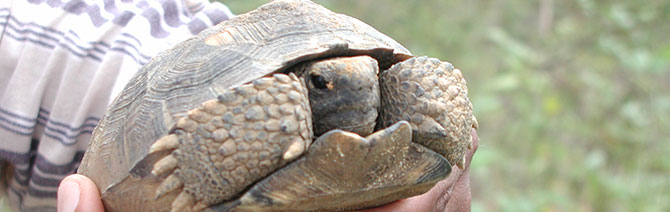 Gopher tortoises can weigh up to 15 pounds.
No matter if we’re working on transportation or land development projects, this is an imperative step in the permitting process. To be granted a permit, contractors are required to have gopher tortoise authorized agents survey land for burrows no more than 90 days prior to construction. On average, burrows are 15 feet long and seven feet deep, but depth is dependent on local soils and the location of water tables. Further inland where water tables are significantly lower, this species may burrow upwards of 15 feet deep. Towards the outskirts of the state where water tables are higher, burrows tend to skim the surface of the water table.
A Keystone Species
As a keystone species—one that provides some form of support for other animals—this burrow also offers refuge and shelter for more than 350 other creatures, including ESA-listed species such as the gopher frog and eastern indigo snake. Protecting the gopher tortoise is critical not only for its long-term survival, but also for the safety and survival of many other animals. During the aforementioned survey phase, authorized agents locate onsite burrows, both potentially occupied and abandoned. Although there are a few ways to remove gopher tortoises from their burrows, the method most commonly used involves a backhoe digging up roughly 80 percent of the ground above the burrow as agents track it with flexible PVC piping. Once the end chamber is reached, authorized agents carefully remove the tortoise by hand and transports it to specialized refuges where biological data is tracked.
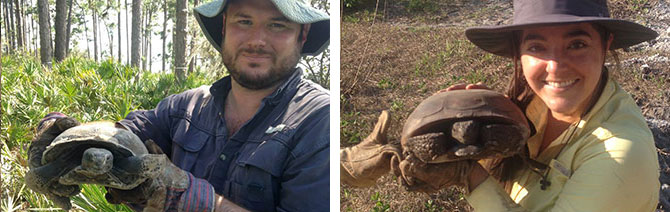 Jason Perryman and Eileen Cassidy are pictured here with two of the recently removed keystone species from a project site in Orlando, Florida.
After the area has been surveyed, cleared of gopher tortoises, and approved for construction, silt fencing is installed around the perimeter of the construction site at a minimum of eight inches deep in order to keep additional gopher tortoises from wandering onto the project site. If more are discovered during any part of the construction process, authorized agents return to the site to remove and transport them to refuges.
Valuable Members of the Ecosystem
In the last two years, we have extracted nearly 30 gopher tortoises from all across Florida. Our goal is to continue to care for this threatened, keystone species, which provide such valuable contributions to much of Florida’s wildlife and ecosystems.
About the Author