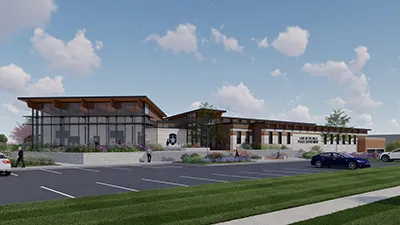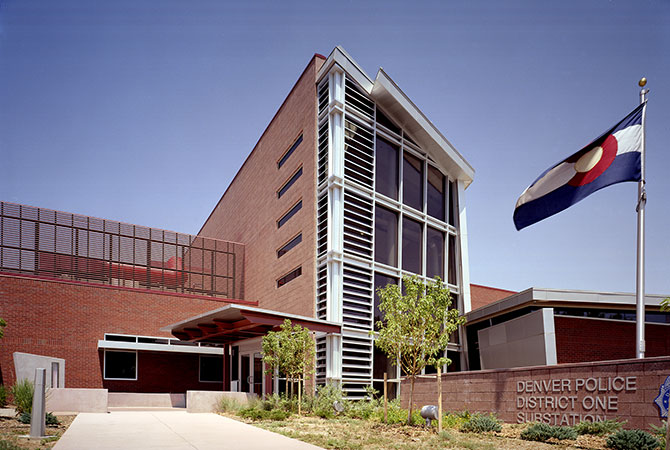
I recently visited Dewberry’s Denver office and had the opportunity to explore some of the police stations we designed for the city about ten years ago. Denver Police District Station House No. 1 served as a prototype facility, designed to blend in with the neighborhood and help promote the city’s policy of community policing. We were also the architects for stations 2 and 3, working with the local firm of DRA Architecture.
These buildings are still among my favorites. There were a lot of neighborhood meetings with input from local residents. When Station House No. 1 opened, the district commander handed over the scissors to community leaders for the ribbon cutting and said, “This is your building. We’re here to serve you.”
Welcoming the Community
The stations are neighborhood-friendly buildings—welcoming rather than imposing. They feature large and open lobbies and are constructed using durable materials that would allow for constant community use. In revisiting these buildings, I walked around inside and out, and was pleased to see how well the materials and workmanship were holding up.
For each station, our team devised a floor plan configuration that created four zones: community, police-community interaction, police interaction, and a secure area. District Station House No. 1, which won multiple awards, was also carefully designed to blend in with both the historic red brick buildings in the neighborhood as well as the newer high-tech buildings that were being introduced by that time.
Lessons Learned
With police buildings, like many specialized facilities, it’s important to study what has worked well through the years and what might be improved. The commanders at the stations I visited were welcoming and very appreciative of what we had designed in terms of the flexibility and the buildings’ ability to support police operations. They told me that the stations had the right infrastructure and adapted well as the operational “state-of-the-art” evolved.
At the time, everyone involved, including city and police representatives and community leaders, hoped that the stations would be somewhat iconic, and serve as touchstone buildings that would spur further community revitalization. That also held true, and the neighborhoods have improved—a trend we see with community-based police stations nationwide. In these Denver communities, there is clearly a sense of pride and local ownership of these buildings, just as we had hoped.