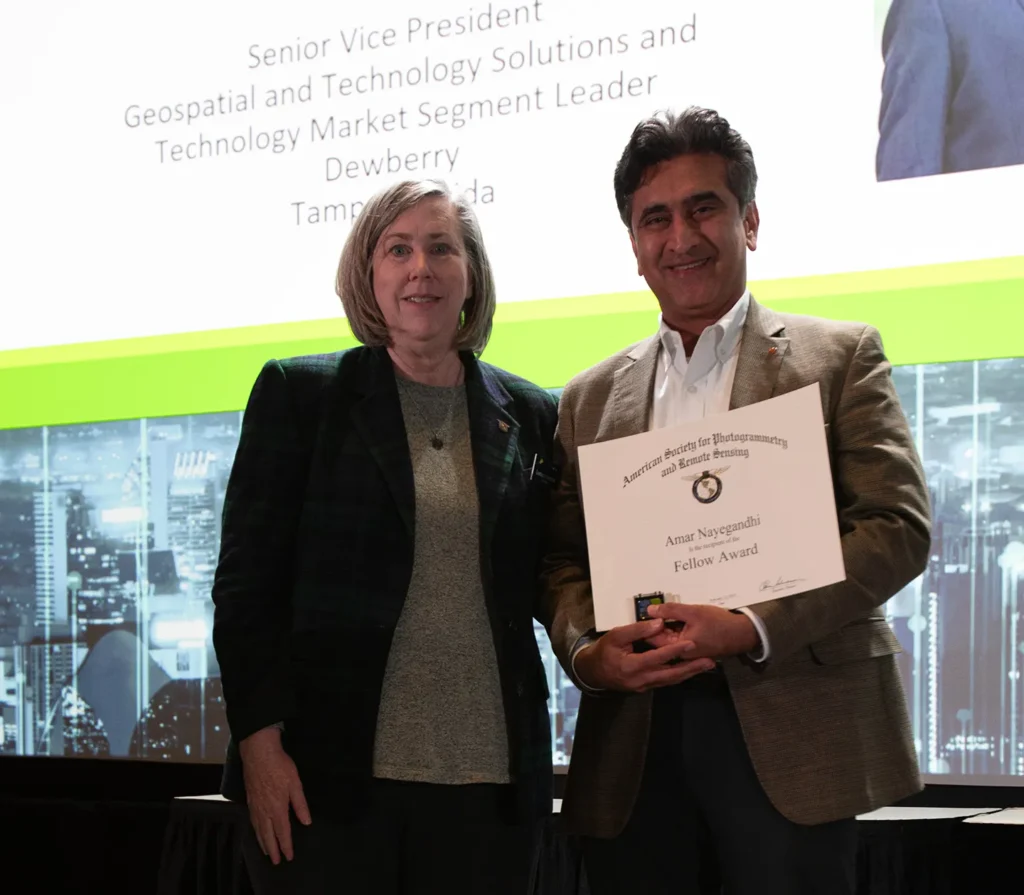
Dewberry, a privately held professional services firm, has announced that Senior Vice President and Operations Unit Manager Amar Nayegandhi, CP, CMS, GISP, has been honored by the American Society for Photogrammetry and Remote Sensing (ASPRS) with a Fellow Award. The award honors society members who have been active for a total of at least 10 years and have performed exceptional service in advancing the science and use of the mapping sciences and related disciplines. Nayegandhi has been a member of ASPRS since 2005, previously serving as director of the lidar division.
Nayegandhi has nearly 25 years of experience and joined Dewberry in 2011. He leads the geospatial and technology services (GTS) group and technology solutions market segment at Dewberry. He is skilled in airborne topographic and topobathymetric lidar and has presented his research and technological findings at more than 100 international conferences and technical workshops, including the United Nations World Geospatial Information Congress (UNWGIC) in Deqing, China. He has also co-edited ASPRS’s “Digital Elevation Model (DEM) Technologies and Applications: The DEM User’s Manual, 3rd Edition.”
“It is an honor to receive the Fellow Award,” says Nayegandhi. “My time with ASPRS has had such a positive impact on my career, and I am grateful for the connections and opportunities the society has given me.”
Nayegandhi earned a master’s degree in computer science from the University of South Florida (2001) and a bachelor’s degree in electrical engineering from the University of Mumbai (1998).