It’s been a decade of high-visibility disasters, and they’ve brought the topic of resiliency to the forefront of local conversations. To their credit, local government leaders have heard their constituents’ cries for more resilient communities and are investing in resiliency. However, much like what took place in post-Sandy northeast, making these high-visibility investments require sound planning and prioritization. To determine and justify them, leaders are searching for outcome- and predictive-based recovery approaches that increase resiliency and reduce future risk.
Qualitative, when the Quantitative isn’t Available
We define resiliency as a community’s ability to quickly recover from a major incident, such as a natural disaster or terrorism attack, and unfortunately, quantitative ways to predict resiliency are proving elusive. The Earth experiences the most unpredictable weather patterns in our solar system. Compound this natural unpredictability with increased event magnitudes and things simply move too fast for even the best of us to narrow down justifiable quantitative measurements.
With an atmosphere complex enough to support life yet complicated enough to produce devastating typhoons, how can we predict resiliency and recovery? Two industry-leading research papers out of the University of South Carolina focus on qualitative indicators in lieu of quantitative measurements.
The Formula
Susan L. Cutter and Christopher G. Burton have created a complex formula that, when simplified, relates vulnerability and resiliency. Compare these two characteristics and then toss a wrench into the system (the disaster, or “Event”) to get an idea of your community’s ability to recover or withstand a major incident.
In a formula, it might look something like this: [Vulnerability + Event] > or < Resiliency
If the sum of your community’s vulnerabilities paired with the effects of a disaster (or a series of negative events impacting your community) ends up being less than your ability to absorb and recover from the event, there’s a good chance you’ll weather the storm and prove resilient. If that same sum ends up being more than your resiliency, there’s a high chance your safety is in jeopardy.
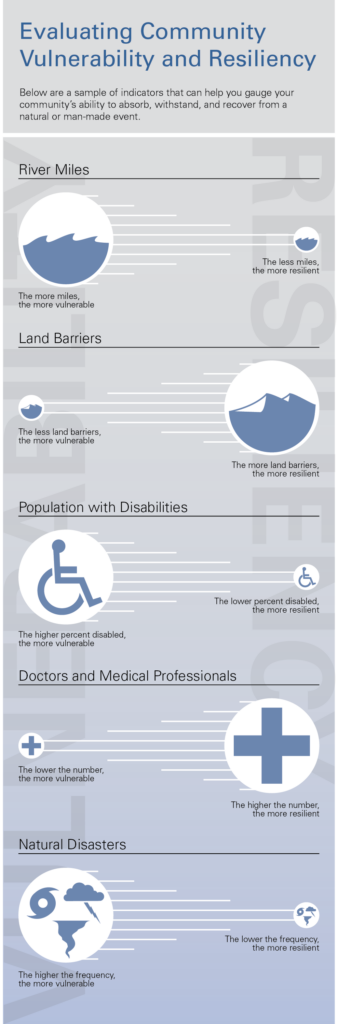
The papers cite more than 40 indicators that can either be evaluated to contribute to vulnerability or resiliency. For example, let’s say the disaster in the equation above is a hurricane. Rivers, measured in miles, can either add to a community’s resiliency if there are none nearby, or be a major vulnerability if one runs right through town. Other indicators, like the number of town doctors, add to a community’s resiliency with greater numbers, but become an area of vulnerability with fewer numbers. As the infographic below illustrates, each of these indicators exists somewhere between extremes of vulnerability and resiliency.
So how can you predict community resiliency and recovery? Well, it helps to have collaboration from community leaders and outside professionals to truly monetize vulnerabilities and resiliencies. While developing a fully workable model is a challenge, it greatly improves communities’ preparedness. This research is helping leaders recognize their communities’ limitations, and understanding absorptive capacity is the first step towards realizing community resiliency and recovery.
About the Author