How many ways can you make a left hand turn? The first, most obvious solution is to move in a counter-clockwise direction. Or, you could just turn the other way long enough to be facing what was originally left. That’s it, right? Well, when it comes to
transportation, and heavy through-traffic volumes of 1,350 cars/hour go against even heavier peak-hour left turn volumes of 1,410 cars/hour, there has to be a better solution. That solution is known as the continuous flow intersection (CFI).
Improving Function and Reducing Cost
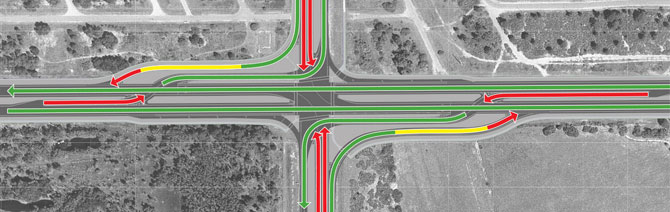
A CFI is an innovative at-grade intersection that removes conflicting left turns at an intersection by placing the turning movements several hundred feet in advance of the main intersection. This eliminates the “left turn arrow” signal phase completely.
Vehicles turning left cross into special left turn bays prior to taking the turn onto the cross street. The major advantage of this is that the left turn movement and mainline thru movements occur simultaneously, reducing intersection delay. CFIs
also notably increase safety by reducing the number of conflict points at the main intersection. On the side streets, right turns are ushered through slip lanes that merge onto the mainline roadway, downstream of the intersection.
The original design was created by a Mexican engineer, whose patent was recently lifted. There are only a dozen CFIs that exist in the United States – some in Utah, some in Louisiana, and there will soon be one in South Florida.
Making Innovation Mainstream
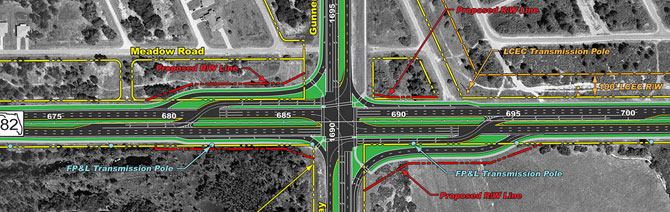
We’re proud to be designing the first CFI in the state of Florida, located near the City of Fort Myers. This intersection is an integral piece of a State Road 82 six-lane capacity improvement project in Lee County, and is part of three adjacent Florida
Department of Transportation (FDOT) design contracts we are working on that cover 11 miles of southwestern Florida.
The CFI at the intersection of State Road 82 and Daniels Parkway/Gunnery Road was not FDOT’s original solution. During the preliminary project development phase, FDOT wanted plans for a grade-separated single-point urban interchange (SPUI). After evaluating
other solutions, FDOT decided to proceed with final design of the CFI because it offered comparable levels of service flow and substantial cost savings over the SPUI alternative.
Making the CFI Our Own
Our team has faced several challenges since beginning the final design in early 2010. We had to provide a unique traffic signal layout, scale the geometry appropriately to accommodate large semi-tractor trailers, and accommodate both pedestrian and bicycle
traffic. Our solution to the first situation was to incorporate a strain pole layout with a box span wire; the second was solved by performing iterative analysis; and we drew our third solution from the lessons learned from other CFI designers.
There are only about a dozen CFIs currently operating in the United States, but this innovative concept is becoming more widespread as a viable solution to alleviate some of today’s congested intersections. It is an attractive solution, comparable to
a grade-separated interchange but developed at a fraction of the cost.
Dewberry | Bowyer-Singleton, acquired by Dewberry in 2013, is performing this work.
About the Author