In mid-September 2013, a powerful storm system overwhelmed Colorado’s available flood prevention measures. This five-day natural disaster forced more than 11,000 evacuations and damaged more than 19,000 homes. More than 1,750 citizens were rescued from areas cut off by swollen waterways and numerous roads, bridges, and other streamside infrastructure were damaged or destroyed. During the beginning stages of this event, we realized that one of our client’s tools could be used to keep a large amount of Colorado citizens informed of current and future flooding threats – and we helped them expand the reach of the tool by using social media.
The Colorado Water Conservation Board funds the Colorado Flood Threat Bulletin (FTB) program to provide the state’s emergency response and management community with proactive flash flood and flood forecasts on a county-specific basis. Designed and maintained by Dewberry, the website provides daily forecasts and GIS maps of flood threats across the state from May through September. The website is visited by about 20 emergency managers daily, and rises slightly on days with greater flood threats. With a focus on the technical meteorological conditions driving a flood threat, the site is not geared towards public consumption. However, during these mid-September storms, we recognized that this tool could be used to broadcast information not only to response and recovery teams, but also to the general population as a whole.
Creating Something Viral
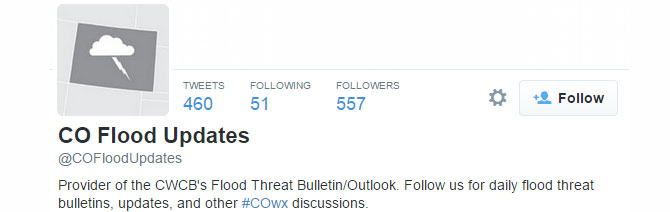
We set up a Twitter account, @COFloodUpdates, with the goal of disseminating the site’s flood forecast information to not only our normal audience of emergency managers, but also to the media and the 2.5 million people in areas impacted by the flood. Twitter, a social media platform built to distribute information quickly and effectively to a large audience, has a proven record of being the go-to news source during disasters. It has a unique ability to exponentially drive viewership depending upon the number of “re-tweets” and “followers” an account accrues. By establishing our handle as a one-stop-shop for the most important flooding information, it soon became a recognizable source of information.
We began by sharing videos, photos, road closures, forecasts, and other emergency information from all over Twitter: news stations, emergency managers, first responders, and even victims. We then began broadcasting “nowcasts” – real-time tweets containing updated meteorological conditions.
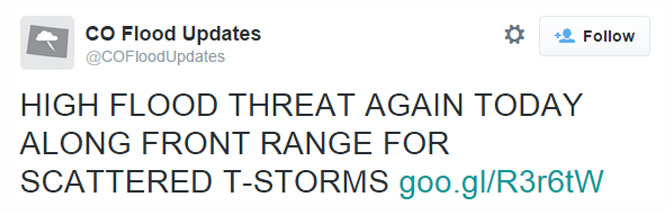
FTB alerts were then released at strategic times and with specific hashtags to both provide flood updates and guide people to the site, where more information was available. These FTB alerts quickly received endorsements from significant Twitter users: the CWCB’s Flood Decision Support System, the Colorado Office of Emergency Management, local reporters, and national journalists.
Expanding a Resource’s Reach
The use of Twitter not only underpinned the FTB’s original mission of providing an accurate and descriptive database for flooding events, but expanded it by providing such information to the general population. In only 18 days, total visits to the FTB tripled, and the website’s Colorado reach increased more than threefold, bringing new users to the site from almost 40 new Colorado cities.
By concentrating solely on the emergency management community leading up to the flooding event, the FTB received a total of 1,845 visits. During the worst four days of flooding, and once the Twitter account was established, the site received 7,726 visits.
By the end of the storm near the end of September, more than 17 percent of FTB visitors came directly from Twitter, the highest percentage from a single source. This statistic highlights how influential differentiating mediums can be to broadcasting information that could keep people out of harm’s way.
About the Authors

Bradley Workman