The telecommunications industry is evolving. Wireless communication service is no longer considered a luxury; it’s become a part of everyday life and a key element for emergency responders. Whether at home, a professional basketball game, or a university, consumers are accessing the internet to do business, stream video, remotely access data, or just socialize. With 85 percent of Americans online, wireless use is quickly replacing land line phones and desktop computers with smart phones and wireless tablets.
Our work as telecom engineers has evolved as well. Our pen-and-paper designs, measurements, and formulas don’t always effectively translate into visuals that show how this critical infrastructure will look once constructed. To meet the zoning requirements of many municipalities and help facilitate the approval of telecom sites, we utilize photo rendering to allow stakeholders to visualize the final installation. These scaled model views from multiple vantage points give a real sense of the location and size of the proposed equipment.
This is why the art of PhotoSimulation, or PhotoSim for short, has become an essential part of the approval process. Some of the simulations we create are so lifelike that there is almost no perceivable difference between what is real and what is simulated.
Dedham, Massachusetts
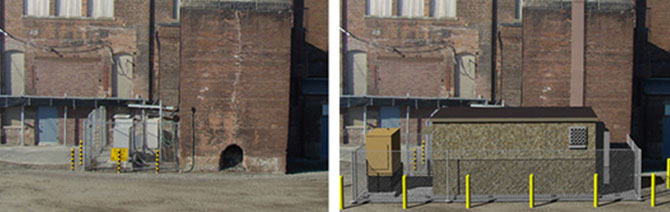
The image below is a PhotoSim we did for a client in Dedham, Massachusetts. The left image is before our digital work, and the image to the right is the final rendering showing a telecommunications shelter, backup generator, fencing, bollards, and cable tray. These images were used by the client to help obtain zoning approval for the telecommunications installation.
West Dover, Vermont
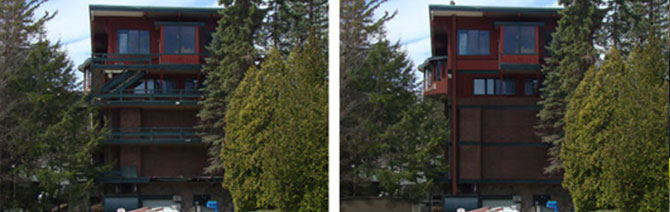
The image below is a PhotoSim we did for a client in West Dover, Vermont. The left image is what exists, and the image to the right is the final rendering. Here, we proposed the removal of the exterior deck and ballast mounted antennas on a lodge at Mount Snow to provide wireless communication service to the area.
Beverly, Massachusetts
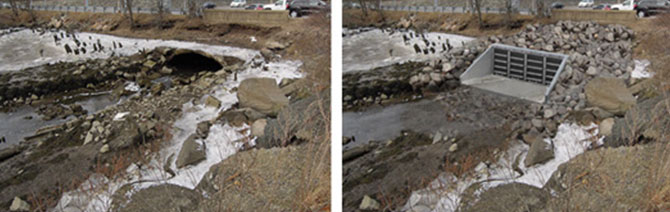
We use PhotoSim work with other engineering services as well. This is a PhotoSim of a proposed technical solution of a tidal flap gate in Beverly, Massachusetts, to mitigate flooding at a 77-acre lakefront corporate campus during a tidal or extreme rainfall event.
Our goal is to make clients see what is not yet there. To visualize the final product exactly as we see it in our minds.
About the Authors
Jorge Montoya